Passion Over Perfection

A Poor Regulator but a Powerful Spring

Getting Closer to Jesus: Minus the infamous Judas Iscariot, Simon Peter usually takes a beating when evaluated alongside the ten disciples. He gets labeled as the stumbling, bumbling, think-before-you-speak, foot-in-the-mouth, inconsistent goofball from Galilee, who, for reasons God only knows, got chosen to be one of Jesus’ first disciples. Good old Peter—the first-century version of Gomer Pyle in the Lord’s little band of foot soldiers.

But let’s give Peter some credit. He may not have been perfect—by a long shot—but he sure was passionate! And he was there—at least give him that. In John 18, as Jesus was arrested and brought to trial, when everyone else but John had fled, Peter figured prominently. He was like a bull in a china shop—passionate, yes; perfect, no—but he was there:

  • He whacked off the ear of one who came to arrest Jesus. (John 18:10-11, NLT) Passionate—but misguided!
  • He surreptitiously followed as the High Priest’s SWAT team took Jesus to jail. (John 18:15-17, NLT) Passionate—but fearful!
  • He stood among the soldiers as they warmed themselves by the fire. (John 18:18, NLT) Passionate—but silent!
  • He denied knowing Jesus when questioned, but at least he was there to be questioned. (John 18:25, NLT) Passionate—but weak!
  • He doubled down on his denial when questioned again. (John 18:26-27, NLT) Passionate—but fundamentally flawed!

Yes, Peter was all those things we’ve said—there is no doubt about it—but passionate? You bet—imperfect, but passionate to the core! Perhaps that is why Jesus gave Peter so much public attention and placed him so prominently on his leadership team. Like the very flawed King David, Peter had a heart after God.

God can use people like that. In fact, I suspect God prefers them over the perfect. Oh, and just a little a hint: There are no perfect people, only those who think they are. Of course, I am not excusing Peter’s imperfection; only explaining it. But I think the reason the Gospel writers included Peter’s gaffes with regularity was not to put him down as the dunderhead we often think he is, but to remind us that God uses imperfect people, especially the passionate ones!

Take the Next Step: Ask God to give you greater passion. Pray for self-control and wisdom, too—but if you are like me, you probably need more passion than the other two.

The Second Amendment—Or The Great Commandment

Think Christianly About the Matter

Getting Closer to Jesus: A few years ago, responding to the mass shooting in my home state at a community college where nine people were murdered—apparently targeting Christians— Tennessee Lieutenant Governor Ron Ramsey encouraged fellow Christians who are serious about their faith to consider getting a gun.

Is it time for believers to arm themselves? After all, Jesus said that increasingly the world will hate us because of our faith in him. Just read John 15:18-25 as well as all of John 16 for that bit of cheery news. Things are going to get rough for believers as the time for the Lord’s return draws close (which, by the way, Christians around the world have known all along. We in America are just discovering, much to our dismay, that this may include us, too!)

But when Jesus predicted this rise in hostility—and even violence—against his people, did he anticipate that they would arm themselves to the teeth to push back against the persecution? Did he foresee the Second Amendment would be our Constitutional right, and therefore we should use every legal means to defend ourselves as American Christians? For the Christian, does the Second Amendment trump the Second Commandment (Matthew 22:37)…or does the call to lay down our lives override the right to take up arms? Is this an either/or conundrum, or can the believer in Jesus grasp the one without letting go of the other (Ecclesiastes 7:18)?

Seriously, these are questions American Christians need to grapple with. Now I say “American” because for Christians in other countries, these options aren’t even in the realm of possibility—which is probably both a blessing and a curse. In our nation, as citizens, we have constitutional rights, and as Christians, we have Kingdom values. Most of the time, these rights and values peacefully coexist, but at times, the earthly and the heavenly kingdoms are in conflict. Sometimes, what may be constitutionally legal may not be eternally bless-able. At those times, to be both a good citizen and a good Christian, the believer must be willing to do the hard work of “thinking Christianly” about such matters. That is, the follower of Jesus must be completely open to the original meaning and full intent of God’s Word, allowing Scripture to impose its unfettered rule over everything in the believer’s life.

Having said that, I think it is fairly clear here that Jesus wasn’t thinking his followers would lock and load in the face of opposition and hostility. In fact, he says as much: “Put away your AK-47, Peter. Do you think for a minute I’m not going to drink this cup of suffering the Father has assigned to me for the redemption of the world?” Later in the chapter (John 18:36) as Jesus is standing at trial before the Roman Governor, Pontius Pilate, he said, “My kingdom is not of this world. If it were, my servants would fight to prevent my arrest by the Jewish leaders. But now my kingdom is from another place.”

So, back to the issue at hand in our modern American culture: Should a Christian take up arms to defend themselves against the coming hostility? I will leave that to you to come up with your own answer—but I would ask you to allow what Jesus says here in John 18 to inform your opinion. Do the hard work of thinking Christianly about this matter. And at some point, as believers, we all need to remember that we have been called as citizens of another Kingdom to surrender our human rights—just as our leader did—for his eternal cause.

Yes, as citizens of the United States, we have the right to bear arms. But as citizens of God’s Kingdom, our calling it to lay down our lives!

Take the Next Step: Your assignment this week is to think Christianly about your right to bear arms. Theologian Walter Wink offered this thought: “Jesus did not advocate non-violence merely as a technique for outwitting the enemy, but as a just means of opposing the enemy in such a way as to hold open the possibility of the enemy’s becoming just as well. Both sides must win. We are summoned to pray for our enemies’ transformation, and to respond to ill-treatment with a love that not only is godly but also, I am convinced, can only be found in God.” Agree or disagree with him, how will you balance the Second Amendment with the Great Commandment?

The Familiar Place

Making Space for Jesus

Getting Closer to Jesus: We know this grove of olive trees was called the Garden of Gethsemane. By the other Gospel accounts, we also know that when Judas showed up with the guards to arrest him in this very place, Jesus was in deep and agonizing prayer. What may be lost in the greater drama of Judas’ betrayal and Christ’s passion, however, are the words, “Jesus had often gone there with his disciples.”

This was a regular place for Jesus. The disciples were familiar with Jesus’ garden retreat; so was Satan, since he knew to inspire Judas to betray the Savior there. Jesus had gone there often enough that those who knew him knew that would be the very place where he prayed.

Have you ever wondered why John took this small, seemingly insignificant detail and tucked it away within the more obvious storyline of Jesus’ arrest? Perhaps he wanted us to see what was plain to Jesus’ disciples: That even the Son of God carved out the time, made room, and even found a physical place in his life for regular communion with his Father. Furthermore, Jesus had purposely included his disciples in his private times with God to leave an example for them as a reminder that if he, the very Son of God, needed quiet time, so did they.

So do I—and so do you.

Do you have that regular place? Do the people in your life know where you spend time with God? Does the devil know where to find you? The place itself is not important. The fact that people know you are regularly in that place is not important. What is important is that you are in that place where you can touch God and God can touch you with his love and grace. By the way, since Satan knows you are there, too, he will have to get past Jesus, since he is there, to get to you.

So, again, I ask, “Where do you make space for time with Jesus?”

It is said that early African Christians were dedicated and regular in their personal devotion to God. Each one reportedly had a separate spot in the thicket where he would pour out his heart to God. Over time, the paths to these places became well-worn. As a result, if one of these believers began to neglect prayer, it was soon apparent to the others. They would kindly challenge anyone neglecting their prayer life, “Friend, the grass grows on your path.”

Keep the path to your Gethsemane well-worn!

Take the Next Step: Perhaps making this very moment of devotion a regular part of your life that you fiercely guard will be the beginning that “familiar place” for you.

It’s Worth The Effort

Don’t Underestimate the Power of Unity

Getting Closer to Jesus: Jesus spent his last hours on earth praying desperately for the unity of his church. He knew that without unity, the church would fall apart. With unity, however, Jesus knew that nothing could stop his people from accomplishing the mission of reaching the world with the Gospel.

That is the power of unity. The great preacher Vance Havner once said, “Snowflakes are frail, but if enough of them get together they can stop traffic.” So it is with the church. If we get together in unity, we will stop the traffic in our community.

The question is, since we all agree that unity is a powerful and necessary thing, how do we move from agreement to action? How can we practice unity? The Apostle Paul provided some powerful insights in his words to the church in Ephesus:

As a prisoner for the Lord, then, I urge you to live a life worthy of the calling you have received. Be completely humble and gentle; be patient, bearing with one another in love. Make every effort to keep the unity of the Spirit through the bond of peace. (Ephesians 1:1-3)

Did you notice that word, “effort?” Paul says we are to “make every effort” to attain and maintain unity in our church. Frankly, it takes hard, focused, continual, intentional, and strategic effort individually and corporately to keep the church united as one.

The word “effort” means to be diligent, to be zealous, to make haste to do something, in this case, being eager and fully dedicated to maintaining the unity of the Spirit. It refers to a holy zeal in guarding our Christian unity. Why do we need holy zeal? To counter Satan’s unholy zeal in dividing us. Satan’s number one goal for the church is disunity. That’s why each Christian needs to take personal responsibility for the spiritual unity of his or her church.

James Hewitt tells the story of one woman’s unforgettable experience teaching Vacation Bible School with her primary class. The class was interrupted one day about an hour before dismissal when a new student, a little boy, was brought in.

The boy had one arm missing, and since the class was almost over, she had no opportunity to learn any of the details about the child’s disability or his state of mind. She was afraid that one of the other children would make a comment and embarrass the poor little guy, and there was no time to warn them to be sensitive.

As the class time came to a close, she began to relax. She asked the class to join her in their usual closing ceremony. “Let’s make our churches,” she said. “Here’s the church and here’s the steeple, open the doors and there’s…”

Then the awful reality of the situation hit her like a ton of bricks—the one-armed boy couldn’t make a church with his hands. The very thing she’d feared the kids would do, she’d done. As she stood there speechless, however, the little girl sitting next to the boy reached over with her left hand and placed it up to his right hand and said, “Hey Davey, let’s make the church together.”

Yes! Let’s make the church together. Believe me, it will be worth the effort!

That is what we need to do—to give every ounce of energy to keep the unity of the Spirit with other believers. And, as the psalmist reminds us,

Behold, how good and how pleasant it is for God’s children to dwell together in unity! … For there the Lord commands the blessing— even life forevermore.” (Psalm 133:1,3)

Do you want God to command his blessing to be upon you? Then make every effort to promote and achieve unity among the family of God in which you have been planted!

Take the Next Step: There is nothing more important to God the Father than the unity of his family. Do you give much thought to that? What strategic and intentional part can you play to attain, maintain, and increase the unity of the Spirit through the bonds of peace in your spiritual community?

In It But Not Of It

A Tough Assignment, But Jesus Has Prayed For You

Getting Closer to Jesus: I cannot think of a more difficult assignment that you have today than to live in the world but not be of it. Yet that is the exact calling that God has placed upon your life. You must live as light on a spiritually dark planet, yet not be absorbed by the darkness; you are to be gospel seasoning in a godless world without losing your God-flavor.

To get out of balance on either end of that assignment, which is an easy thing to do, by the way, is a recipe for spiritual uselessness at best, and spiritual offensiveness at worst. Some Christians have assumed their assignment is to retreat from the world so far that they are insulated from sin. Great—all they have succeeded in doing so is making themselves weird and forfeiting any ability to attract people to the joy and abundance of the Kingdom Life. Other Christians, much larger in number, have gone so far the other way and have so blurred the lines between believer and non-believer that the world has no way of seeing in them the attractive beauty of Christ’s holiness. Not only that, but they have not made God happy in the process.

It is a tough act to pull off: To be in the world yet not of it. But Jesus, himself, has prayed to his Father for you—so that gives you a fighting chance. Not only that, Jesus himself has set for you an example of how to live in the culture and not be absorbed by it. It’s called the incarnation.

The truth is, wherever Jesus went, not only was he untainted by the sinful world, but his life was also so compellingly different that he drew unbelievers to the Father like bees are drawn to flowers. Furthermore, Jesus himself promised to send you the Holy Spirit to lead you, guide you, walk with you every step of the way, and empower you to live in this world but be set apart from it as a living witness of the grace of God.

It sounds like your assignment, as difficult as it may be, is completely doable since Father, Son, and Holy Spirit are on Team You!

So, go do the righteous thing!

Take the Next Step: Read John 17 out loud today, and absorb the words as Jesus prays for you. I promise, you will be encouraged.

The Unceasing Doxology

Our Prayers Reveal Our Focus

Getting Closer to Jesus: Let me listen to the content of your prayers and I will describe your theological grasp of God as well as the level of your spiritual maturity. Not that I want to throw a wet blanket over your access to the throne room of your Heavenly Father nor make you second guess the kinds of things you are praying for.

Obviously, we have been invited to “ask for what we wish” in prayer (John 15:7), to “approach God’s throne of grace with confidence” (Hebrews 4:16) and to freely “pour out your hearts to God, for he is our refuge.” (Psalm 62:8) Nothing, no one nor any teaching should ever cause us shrink back from the privilege of openly and authentically connecting with our loving Heavenly Father in prayer.

Nevertheless, the kind of prayers we consistently pray reveals the kind of Christian we are. So if you are concerned about becoming more like Christ in your spiritual journey—as we all should be—then the content of your prayers over time must turn toward the kind of focus Jesus had every time he prayed.

In this prayer recorded in John 17—what we call Jesus’ “high priestly prayer”—the last recorded prayer he offered right before his arrest, trial, and crucifixion, we see an intense, passionate yet calm, centering supplication being lifted to God. We get a glimpse of that which was most important to Jesus—his priorities—of how clear he was about the divine plan—his submission to God’s will—and of what he understood about his Father’s character—his theology. As important as anything in this important prayer was Jesus’s passion for the glory of God.

  • Jesus uniquely understood the glory that emanated from the eternal God, for he had shared in that unfettered glory from the beginning of time (“the glory I had with you before the world began”, John 17:5).
  • Jesus was fully committed to his own life—and death—reflecting that glory to the world (“Father, the hour has come. Glorify your Son, that your Son may glorify you”, John 17:1)
  • Jesus had perfectly and completely testified to the glory of God through his thirty-three years as an earthly man (“I have brought you glory on earth by finishing the work you gave me to do,” John 17:4).
  • Jesus rightly expected that the Father would restore all the past and future glory of the of eternally existent Son, second person of the Holy Trinity, to him as he submitted, body soul and spirit, to the cross for the sin of the world (“Now, Father, give me back the glory that I had with you before the world was created.” John 17:5, CEV).

Yes, what Jesus prayed revealed who Jesus was, how he believed, and what was most important to him. His final prayer tells us that he believed there was no greater theology than the glory of God. It also shows us that there was no more important focus in life than the glory of God. And it reminds us that there was no greater commitment, no greater expenditure of energy, no greater sacrifice for Jesus than to use his one and only earthly life for the glory of God alone.

What do your prayers reveal about you? Your anxiety about God’s competence to care for the details of your life, or your desire for the temporal things of this world, or your passion for quick fixes, pain avoidance, comfort, and prosperity? Over the course of the next few days, pay attention to the content of your prayers to get an honest assessment of what they reveal about your theology and your spiritual maturity. Like me, you will probably realize that your trust, obedience, and understanding need to go much deeper in God.

What if you and I began to shift the focus of our prayers (and our lives) to the glory of God alone? Truly, there is no greater theme in all creation than God’s glory. And if we will begin to passionately invest our praying and our living toward that end, we will not only fulfill the purpose for which we were created, but we will be well on the way to sharing in the glory of the One who rightly deserves it all.

At the end of the day, may it be said of us that the glory of God alone was our unceasing doxology.

Take the Next Step: The early church father, Irenaeus, wrote in his magnificent work, Against Heresy, “The glory of God is the human being fully alive, and the life of the human consists in beholding God.” Spend some moments in prayer asking your Father to make you a living example of a fully alive human being, bringing glory to God alone.

Praying Like Jesus

Getting Closer to Jesus: For many Christians, prayer is a very private matter. But often, Jesus offered his prayers to God in a very public way—never to show off how great he was as an intercessor or to showcase how impressive his prayers were, but simply to model for his disciples how to connect simply and powerfully with his Father. Through Jesus, we come to understand that authentic prayer is in no way about overcoming any reluctance on God’s part to hear and answer our prayer, but rather it is about tapping into God’s desire to graciously give us what we desire and what he wills through our praying.

Jesus gives us several examples of how we can pray like he did. Obviously, the most famous example is what we call the Lord’s prayer—a brief but powerful, simple yet profound way to effectively connect our needs with God’s will. Another touching example of prayer is this one found in John 17, which we now call Jesus’ High Priestly Prayer. This is his final prayer before going to the cross. He knows full well that he will have to suffer unspeakable pain, take the sin of mankind into his sinless spirit, and die the death of a common criminal to redeem mankind, yet, facing that, he still focuses his prayer on us. And he leaves us a beautiful template for how to pray.
Let me encourage you to take a moment to pray through Jesus’ High Priestly Prayer using the guide that follows. Read the verses aloud as a prayer to God, then, using the prayer focus, rephrase Jesus’ prayer in your own words.

Prayer Focus: Glorifying God through your praise—verses 1-5

Father, the time has come. Glorify your Son, that your Son may glorify you. For you granted him authority over all people that he might give eternal life to all those you have given him. Now this is eternal life: that they may know you, the only true God, and Jesus Christ, whom you have sent. I have brought you glory on earth by completing the work you gave me to do. And now, Father, glorify me in your presence with the glory I had with you before the world began.

Prayer Focus: Acknowledging God’s Word and who you are in him—verse 6-11

I have revealed you to those whom you gave me out of the world. They were yours; you gave them to me and they have obeyed your word. Now they know that everything you have given me comes from you. For I gave them the words you gave me and they accepted them. They knew with certainty that I came from you, and they believed that you sent me. I pray for them. I am not praying for the world, but for those you have given me, for they are yours. All I have is yours, and all you have is mine. And glory has come to me through them.

Prayer Focus: Interceding for unity and protection for Christ’s church—verses 11-12

I will remain in the world no longer, but they are still in the world, and I am coming to you. Holy Father, protect them by the power of your name—the name you gave me—so that they may be one as we are one. While I was with them, I protected them and kept them safe by that name you gave me. None has been lost except the one doomed to destruction so that Scripture would be fulfilled.

Prayer Focus: Asking for joy and sanctification—verses 13-19

I am coming to you now, but I say these things while I am still in the world, so that they may have the full measure of my joy within them. I have given them your word and the world has hated them, for they are not of the world any more than I am of the world. My prayer is not that you take them out of the world but that you protect them from the evil one. They are not of the world, even as I am not of it. Sanctify them by the truth; your word is truth. As you sent me into the world, I have sent them into the world. For them I sanctify myself, that they too may be truly sanctified.

Prayer Focus: Lifting the worldwide church of Christ to God—verses 20-23

My prayer is not for them alone. I pray also for those who will believe in me through their message, that all of them may be one, Father, just as you are in me and I am in you. May they also be in us so that the world may believe that you have sent me. I have given them the glory that you gave me, that they may be one as we are one: I in them and you in me. May they be brought to complete unity to let the world know that you sent me and have loved them even as you have loved me.

Prayer Focus: Ask that the love of God will be revealed in you and through you—verses 24-26

Father, I want those you have given me to be with me where I am, and to see my glory, the glory you have given me because you loved me before the creation of the world. Righteous Father, though the world does not know you, I know you, and they know that you have sent me. I have made you known to them, and will continue to make you known in order that the love you have for me may be in them and that I myself may be in them.

This may take a few extra minutes, but it will be well worth your time as you enter into the same kind of praying that Jesus did. And as you do, you can have this confidence that if the Father listened to the Son, he will listen to you as you come to him in the name of his Son.

“Our prayers matter to God—all of them. They rise up to heaven as pleasing incense before his throne.” (https://www.fromhispresence.com/your-prayers-are-this-important-to-god/) God will not answer every prayer according to our desires, yet each prayer is an act of worship offered in faith that blesses the very heart of God. Prayer is practicing the presence of God. It is entering his very throne room in the great court of heaven. It is exercising faith in the One who rewards those who believe that he exists and diligently seek him. It is placing your needs, concerns, and hopes into the hands of a loving Father who delights in your dependence and is pleased to provide for your needs according to his gracious will.

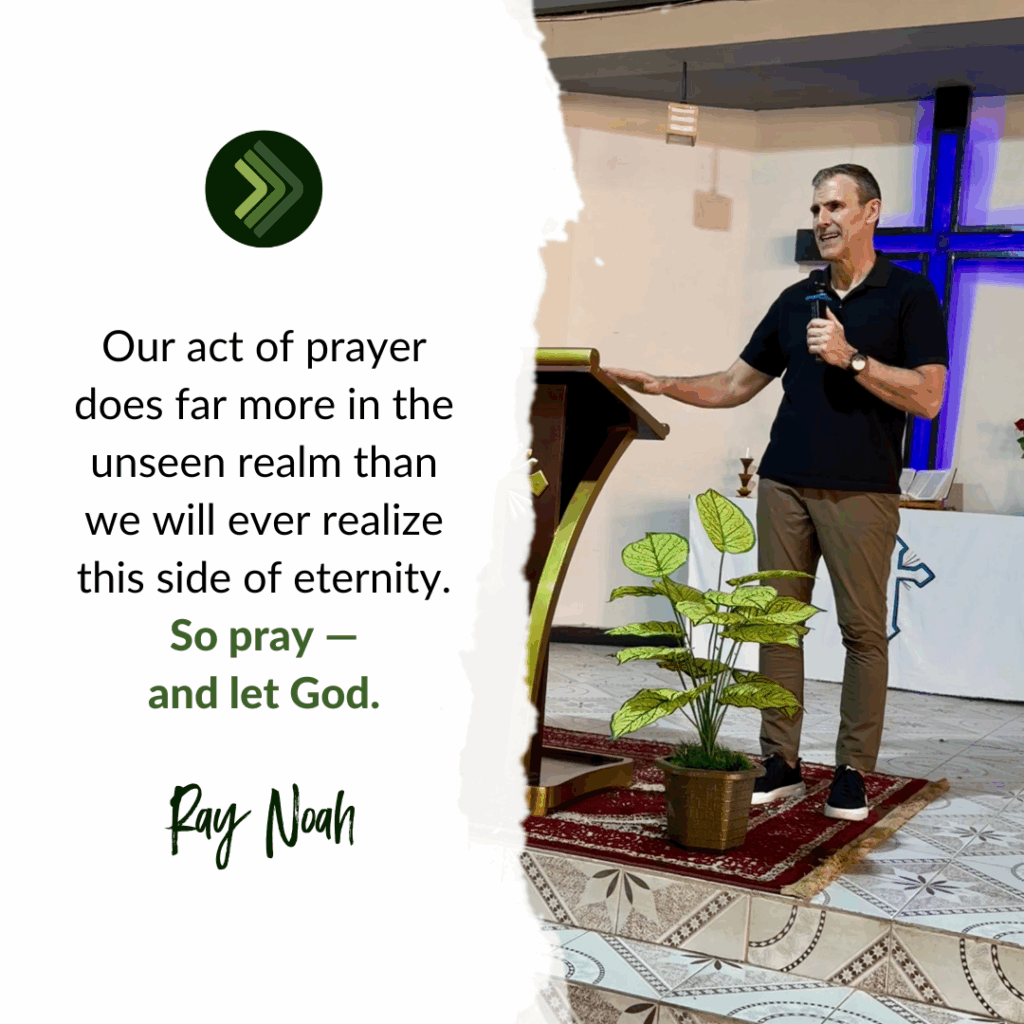
Never forget, your act of prayer does far more in the unseen realm than you will ever realize this side of eternity. So pray—and let God.”

Take the Next Step: Use this prayer guide every day this week, and notice the results in your life. You will be pleased with the things that happen for you—and more importantly, in you.