What Makes You Bless-able

Seize Interruptions as Invitations

Getting Closer to Jesus: If we are to be the kind of Christ-followers that God can bless, our behavior must align with our beliefs. What we “know” must become what we “do.” Specifically, we will have to live like Jesus lived, which means serving like Jesus served. Jesus made that perfectly clear when he said,

You call me “Teacher” and “Lord,” and you are right, because that’s what I am. And since I, your Lord and Teacher, have washed your feet, you ought to wash each other’s feet. I have given you an example to follow. Do as I have done to you.” (John 13:13-15, NLT)

So, how did Jesus serve? Well, an entire book could be written on that, but among the many characteristics of Jesus’ servanthood, he was simply available to people. Reflecting on my own life and the lives of many people I know, my sense is that the critical need for most of us who will read this devotional is to reorient our busy schedules so that serving Jesus by serving others becomes our top priority in life.

Think about how Jesus did that. Matthew 20 tells the story of Jesus walking to Jericho when some blind men start yelling at him: “Lord, have mercy on us!” And it says, “Jesus stopped and asked. ‘What do you want me to do for you?’”
Now think about that: Jesus stopped! God turned aside to make himself accessible to those whom society had cast aside. Jesus did that a lot! Do you realize that most of his miracles were interruptions? What we see as an intrusion, Jesus saw as an invitation—an opening in his schedule to serve God’s purpose by serving God’s people. If we are to grow into a Christ-like ministry mindset, that is the attitude we must cultivate. And here is what that means:

First, we will have to realign our crowded calendars. Matthew 6:33 says, “More than anything else, put God’s work first and do what he wants. Then the other things you want will be yours as well.” What that means is that if you make God’s concerns your priority, he will make your concerns his priority. In other words, that will make you bless-able.

Second, we will have to refocus on others. That means we will need to think a lot less about ourselves and a lot more about others. Philippians 2:4 reminds me that in becoming like Christ, I must “forget myself long enough to help other people.” That is truly the preeminent attitude of Christlikeness. And it is one of the things that leads to a truly satisfying experience of life, giving yourself to others. Again, that is what will make you bless-able.

Third, we will have to relax our perfectionism. Too many Christians wait for perfect circumstances to serve: when life isn’t so hectic, when the kids are out of the house, when the right ministry comes along, or when other stuff gets done first. Ecclesiastes 11:4 says, “If you wait for perfect conditions, you’ll never get anything done.” Christlike servants do their best with what they have for Jesus today, not someday. Like Jesus, they are available when the opportunity presents itself! By definition, a servant always makes themself available to their master, and that is what will make you bless-able to the only Master that matters.

Jesus served because at the core of who he was there was a consuming desire to connect people with the grace, mercy, and love of his Father. Serving was the primary means of that. Since, as a Christ-follower, you are being transformed into his character, that must be characteristic of you, too.

God has made—or more accurately, remade you—to serve him by ministering to others. Actually, “you are God’s workmanship, made to do good works that God himself has prepared in advance specifically for you to do.” (Ephesians 3:10)

Interestingly, and quite deliberately, the Greek word in that verse the Apostle Paul chose for workmanship is poiema. We derive our English word poem from that. You are God’s poem, and when you serve in the mindset of God’s Son, you become poetry in motion.

And when you do, you are at your most bless-able!

Take the Next Step : There is one vitally important question you must answer after you have been saved: Where are you loving God by serving others?

The Delightful Demand of Discipleship

Serving Puts You at Your Christlike Best

Getting Closer to Jesus: If you and I are going to be a fully devoted follower of Christ, we will have to think, speak, and live like Jesus thought, spoke, and lived—not the least of which is to take on the attitude, exhibit the actions, and live the lifestyle of a servant. Yes—you will have to serve as Jesus served!

Serving is what Jesus did because servanthood was at the very core of who Jesus was and why Jesus came. The Gospel of Mark, the first written biographical account of Jesus, sums up the life and ministry of Jesus with this simple, clear, and compelling mission statement:

“For even the Son of Man did not come to be served, but to serve, and to give his life as a ransom for many.” (Mark 10:45)

Fleshing out this mission statement, John 13 presents the servanthood of Jesus in action in the most unusual and unforgettable way: He washed his disciples’ feet. Then, as he completed this humbling task, he said to them, “I have given you an example to follow. Do as I have done to you.” (John 13:15, NLT) It is abundantly clear from this passage, along with other scripture, that serving is an unmistakable, unavoidable demand of discipleship. Not only is serving a demand, but when we look at Jesus’ example, we find that serving is also a delight. It is what makes us bless-able: “Now that you know these things, God will bless you for doing them.” (John 13:17, NLT)

Think about it: Serving like Jesus is what puts you at your Christlike best!

You are called to serve! Paul writes in Philippians 2:5-7, “Your attitude should be the same as that of Christ Jesus: Who being in very nature God…took on the very nature of a servant.” Galatians 5:13 says, “Serve one another in love.” If you are serving, you are fulfilling your basic Christian calling. If you are not, then you are not!

You were created to serve! Like fish swim and birds fly, Christians serve! Ephesians 2:20 states, “We are God’s workmanship, created in Christ Jesus to do good works, which God prepared in advance for us to do.” Before you were even conceived, God laid out specific plans just for you. You are not an afterthought; you do not just exist; you are on this earth not just to be a potted plant, you were born not just to consume, but to contribute. God deliberately shaped you to serve his purposes, which means that he has placed an important responsibility on your shoulders that only you can fulfill.

You contribute to the Body of Christ when you serve! God specifically created you, converted you, and called you to contribute to the life, health, and mission of a local church. Paul taught in 1 Corinthians 12:27, “Now you are the body of Christ, and each one of you is a part of it.” Verse 12 says, “The body is a unit, though it’s made up of many parts; and though all its parts are many, they form one body. So it is with Christ.” Verse 18 says, “God has arranged the parts in the body, every one of them, just as he wanted them to be.” Why? Verse 7 tells us it is “for the common good.” 1 Peter 4:10 says, “Each one should use whatever gift he has received to serve others, faithfully administering God’s grace in its various forms.” Perhaps you didn’t realize this, but as you and others serve in your church, serving becomes the primary means by which others receive God’s grace. Your serving is the conduit of God’s grace to those around you.

You capture the world’s attention when you serve! Our humble, authentic acts of service put God in a good light. Jesus taught in the Sermon on the Mount, “Let your good deeds shine out for all to see, so that everyone will praise your heavenly Father. (Matthew 5:16, NLT) Jesus said John 13:35, “By this will all men know that you are my disciples: That you have love for one another.” It is by authentic servanthood that you become living proof of a loving God.

Jesus ended the washing of his disciples’ feet by issuing this very simple challenge: “Now that you know these things, God will bless you for doing them.” (John 13:17, NLT) It doesn’t get any clearer than that!

Take the Next Step : Having read this devotional and meditated on the scriptures quoted, there is a simple question you are obligated to answer: “Where am I serving?”

Unconditionally Loved

If Jesus Loved Judas, He Will Love You, Too!

Getting Closer to Jesus: It is hard to fully fathom and completely embrace God’s immeasurable, inexplicable, crazy love that is revealed in this moment as Jesus washed his disciples’ feet. The story, which connects us to Jesus’s final hours before his sacrificial death on the cross, begins with this shocking statement in verses 1-2:

Just before the Passover Feast, Jesus knew that the time had come to leave this world to go to the Father. Having loved his dear companions, he continued to love them right to the end.

What makes that so shocking is that Jesus knew full well that not only would his love for these disciples not be reciprocated, but there were also two in that group who would publicly deny him, and actually betray his love: Judas and Peter. Verse 2 goes on to say, “It was suppertime. The Devil by now had Judas, son of Simon the Iscariot, firmly in his grip, all set for the betrayal.” Verse three adds, “Jesus knew…” what the Father had put before him. Then, in verse 38, Jesus responds to Peter’s promise to stand with him through thick and thin, “Actually, Peter, the truth is that before the rooster crows, you’ll deny me three times.”

Now with that in mind, let’s go back and explore what the “full extent of Jesus’s love” looks like in what he did in that intimate setting for his disciples—and more importantly, by extension, what he did for you and me.

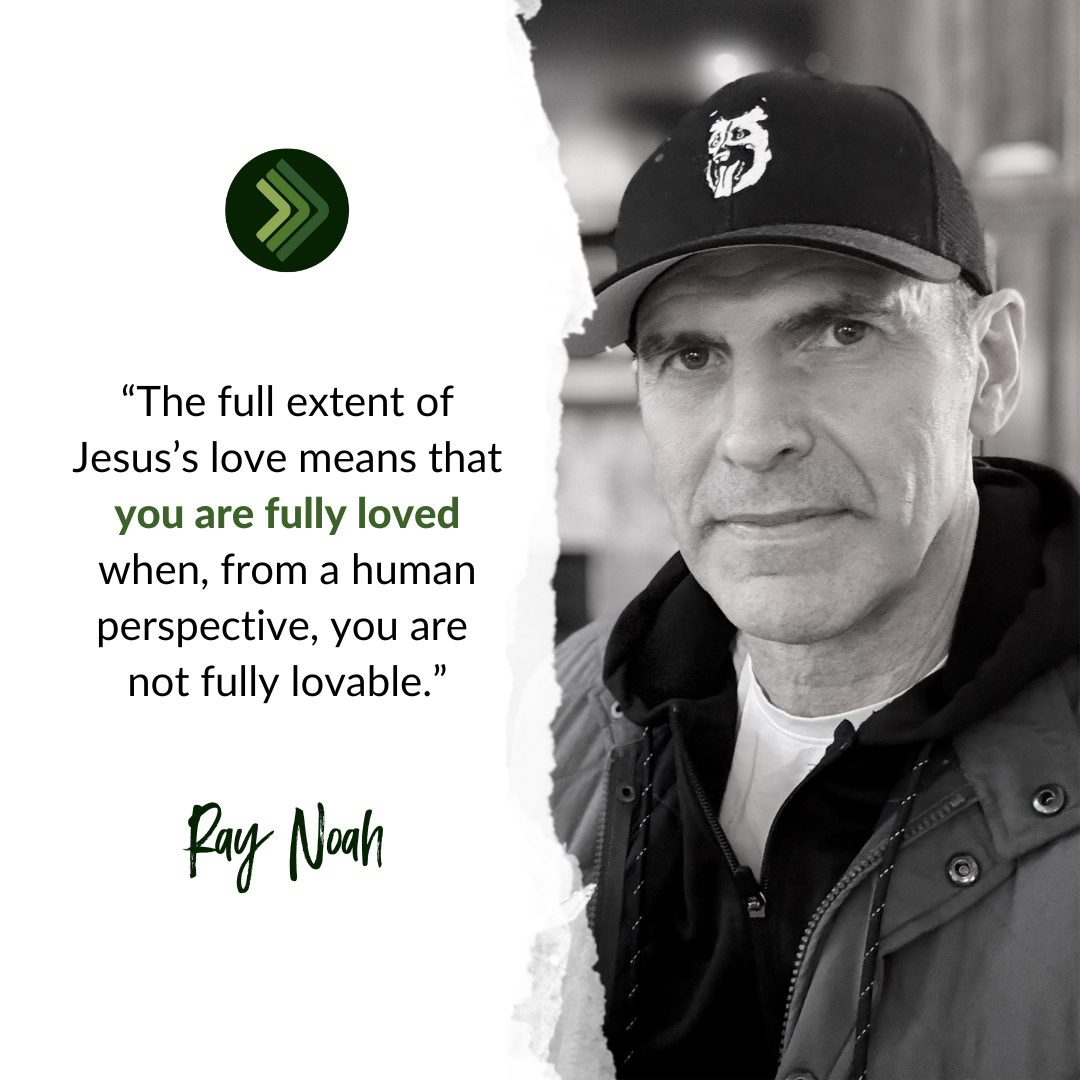
For one thing, the full extent of his love means you are fully loved, when, from a human perspective, you aren’t fully lovable. Verse 2 says, “It was time for supper, and the devil had already enticed Judas to carry out his plan to betray Jesus.” Verse 11 adds, “Jesus knew who would betray him”; that Judas would hand him over to the Jews later that night. I don’t suppose we could think of anyone any more unlovable and unworthy than Judas—yet Jesus loved him, nonetheless.

He humbly knelt as Judas’s servant to wash his feet, knowing everything in his past, present, and future. Yet Jesus still showed him the full extent of his love! What that means is that if Jesus loved Judas, then knowing everything about you—past failures, present junk, and even your future sins—he will still stubbornly love you. If Judas was worthy of love, then certainly you will always be the object of Christ’s unstoppable love. In fact, you don’t have enough sin or darkness to even slow his love down! You are fully loved!

That leads to another thing that you ought to know about the full extent of Jesus’s love for you: It is a love that is rooted in his nature and is not dependent on yours. Verses 4-5 say, “Jesus got up from the table, took off his robe, wrapped a towel around his waist, and poured water into a basin. Then he began to wash the disciples’ feet and to wipe them with the towel he had around him.”

Now think for a moment about those whose feet he washed. Of course, there was Judas, whose betrayal Jesus knew was just moments away. But there was also one he knew would deny him—Peter—who, in spite of his insistence otherwise, famously and publicly denied Jesus. And of course, there were ten others around that room he knew would desert him in his hour of greatest need before the night was out.

Not their character—nor yours—motivated Jesus’s love; no, it flowed out of his own loving character. That’s why you can always depend on being the recipient of the full extent of his love.

Finally, what you ought to know about the full extent of Jesus’ love is that it will transform your worst nature so radically that you, yourself, will become a conduit of his love. Jesus said in verses 34-35, “So now I’m giving you a new commandment: Love each other. Just as I’ve loved you, you should love each other. Your love for one another will prove to the world that you are my disciples.”

That’s what the “full extent of his love” will do—if you let it! Again, that love flows from his character, not yours, but when you surrender to it, you can then enter what will be your most satisfying experience in life: You, yourself, becoming a conduit of his full love to others.

And that is the answer to the deepest longing of your innermost heart: To know the full extent of God’s unconditional love and become the conduit of that inexhaustible love to others!

If nothing could stop Jesus from loving Judas and Peter, certainly nothing will prevent Jesus from showing you the full extent of his unconditional love.

Take the Next Step : Take time today to enjoy God’s love. And if that is hard to imagine, just visualize in your mind Jesus, arms stretched wide as he hangs on the cross, saying to you, “I love you this much!”

The Divine Leverage of Willful Unbelief

Don’t Let Your Agenda Get in the Way of God’s

Getting Closer to Jesus: John 12 is a pivot point in the Gospel of John that marks Jesus’s last public movements before his arrest, crucifixion and post-resurrection appearances. It is one of the most stunning accounts you will find in Scripture because of the unbelief of the characters in this chapter.

Jesus has just performed the greatest miracle you could ever hope for: the raising of Lazarus from the tomb four days after he had died. Yet the reaction of Judas, the priests, and the Pharisees, respectively, to this outstanding miracle is flat-out rejection of Jesus’ deity, if not blind hatred of him. Their unbelief is stunning, given the fact that the now-resurrected Lazarus is standing before their very eyes, living proof of Jesus’s authority and power over death.

Fortunately, this story is more than the sad history of the Jewish establishment’s rejection of Jesus. As is always the case with Scripture, there are valuable lessons to be learned from this about the willful unbelief of humanity and the unstoppable purposes of God.

The first lesson we learn is that miracles alone will never lead people to the full surrender of their lives to the Lordship of Jesus Christ. People often demand a miracle before they will place faith in Christ, but the record of the gospels indicates that miracles alone won’t wash away willful unbelief. They should—but they don’t. Time and again, Jesus performed a miracle, only to have people, in the very next moment, demand not another sign, but a sign—as if the one he had just given hadn’t been given at all. Such is the utter blindness of illogical unbelief. Beware, the next time you find yourself insisting that God grant you your miracle.

The second lesson we learn is that the motives of sinful people will always irreconcilably conflict with the purposes of a holy God. When human beings’ agenda collides with God’s agenda—and it always does, sooner or later—something’s got to give. The Jewish leaders were more interested in protecting their religious and political way of life than in discovering the life of abundance that the Messiah had come to reveal. In this case, unbelievably, they not only rejected Jesus, but the creatures killed the Creator! Keep in mind that early and often in your voyage of faith, you will be called to untether from the shores of comfort and risk what you cling to in order to go with God.

But the third lesson we learn here is that even the inflexible unbelief of man always gets leveraged for the irrepressible glory of God. That is why Jesus quotes Isaiah in John 12:40, “God has blinded their eyes and hardened their hearts—so they can’t see, can’t understand, can’t turn to me and have me heal them.”

Now this is one of the Bible’s hard sayings that seems to say God predestines some people to unbelief. But understand that Isaiah’s complaint springs from the broken heart of a prophet who is bewildered that his message and his calls to repentance only made the people of Israel worse, not better. Yet in their painful and willful rejection of the word of the Lord, Isaiah knew that even this could not take place outside God’s purpose nor thwart his unstoppable plan. Nothing can—which means we best get on board with God’s agenda. So, in that sense, even when people rejected Isaiah’s message, their unbelief was still contained within God’s purpose.

That is not to say that humanity’s unbelief is God’s purpose; rather, it is to say that God sovereignly uses even our unbelief for his sovereign purpose. For instance, in Romans 11, the Apostle Paul said that God used the unbelief of the Jews for the conversion of the Gentiles. God didn’t predestine certain people to unbelief—they chose unbelief—but he used their unbelief to further his agenda. In John 12, the Jews’ unbelief isn’t God’s fault; it’s the Jews’ fault. Yet even then, God is so great that not even this sin of stunning unbelief is outside his power, so he leverages it to bring about the cross and the redemption of all who believe.

Now, if all this is theologically true, what does it mean for you practically? Simply this: God will leverage humankind’s unbelief for his ultimate glory—even yours. But you have a choice. You can either stubbornly hold on to your unbelief—that is, where your agenda conflicts with God’s—or you can surrender it to Jesus so that you can get on board with God’s glorious plan.

What is your area of unbelief, the place where you are fiercely clinging to your agenda? Have you ever withheld money from missional work because it was dedicated to something that you “needed” to do? Have you ever held back from an appeal to serve in your spiritual community because you felt unqualified or too busy or frankly just didn’t want to make the commitment? Have you ever criticized a change in the church that the pastor felt was necessary to reach more outsiders because it conflicted with your comfort and your preferred style of worship? There are a hundred ways we hold on to our unbelief—with spiritual justification—but here’s what Jesus said in John 12:24-25 about letting go of your agenda for God’s:

Listen carefully: Unless a grain of wheat is buried in the ground, dead to the world, it’s never any more than a grain of wheat. But if it’s buried, it sprouts and reproduces itself many times over. In the same way, anyone who holds on to life just as it is destroys that life. But if you let it go, reckless in your love, you’ll have it forever, real and eternal.

If you hold on to what you want, you’ll kill any chance of what God wants for you! To experience the resurrected life—not just in eternity, but now—you must die to your unbelief.

Before you finish this post, I implore you to determine that your agenda and unbelief will no longer control you.

Take the Next Step : Where are you stubbornly holding on to your own spiritual agenda, and thus, expressing willful unbelief? Ask God to reveal to you where you need to surrender your preferences to his ways. Then be ready to obey him ruthlessly.

The Great Disruptor

Meet Jesus, the Polarizer

Getting Closer to Jesus: Historian Kenneth Scott Latourette wrote, “As the centuries pass, the evidence is accumulating that, measured by His effect on history, Jesus is the most influential life ever lived on this planet.”

His was also the most polarizing life ever lived. Now, in our day, perhaps in his day too, to be polarizing is neither an endearing trait nor a winning strategy to get you to the top. But Jesus didn’t care; his mission was to save souls (Mark 10:45), which required him to unflinchingly preach the truth, prove his ministry by mighty miracles that often collided with the established rules of religion, confront, and ultimately die as the only sacrifice that could redeem fallen humanity to set them right with Father God.

To that end, Jesus pulled no punches. And you either loved him or hated him. That was the case here in John 12:37-50. Some people heard his teaching and discerned a level of grace, truth, love, and spiritual authority they had never witnessed in human teachers before. In Jesus, this was the Messiah they had been waiting for. Others heard his teaching and saw his miracles and believed he was the Messiah, but because they were more concerned with maintaining their standing among the Jewish leaders who opposed Jesus, they kept it a secret. And then, of course, there were those who hated him so much they were willing to do anything to kill him off—despite the outstanding miracles they had seen with their own eyes.

Love him or hate him, Jesus forces that choice upon you. As C. . Lewis said,

[With Jesus] you must make a choice. Either He was, and is, the Son of God: or else a madman, or something worse. You can shut Him up as a fool, you can spit at Him and kill Him as a demon; or you can fall at His feet and call Him Lord and God. But let us not come with any patronizing nonsense about His being a great human teacher. He has not left that option open to us. He did not intend to.

And yet while people are still curious about Jesus in our day, far too many are still trying to ride the fence about a man who did his best not to give us that option. I have heard people say, “Oh, Jesus, yeah…he’s a great prophet…he is a marvelous teacher…he’s really something. The guy turns water into wine, feeds thousands with a few loaves and fishes, and cures sick people. Man, this guy is incredible.”

Untold thousands of people, the rich and famous as well as the poor and unknown, wear the cross as their jewelry of choice, the symbol that identifies them more than any other. Athletes, politicians, movie stars, and rock and roll icons whose lives are incongruent with his teachings invoke his name with not a second thought about who he claimed to be. I’ve talked to young men dressed in starched white shirts and ties at my front door who come in his name yet deny his deity. I see raunchy entertainers spew filth in one breath and claim Jesus as a good buddy in the next breath. I have good friends and close family members who acknowledge the historical Jesus yet ignore his teachings and demands. I have witnessed to people who claim to believe in him as a great moral teacher, worthy of deep respect and honor, but certainly not worthy of his Lordship over their lives.

It is amazing what we have done with Jesus! Dorothy Sayers, a brilliant writer and Christian thinker, once mournfully remarked, “[We have] very efficiently [clipped] the claws of the Lion of Judah, certified Him as a household pet fitting for pale curates and pious old ladies.” That he is not, by his own claims:

  • To know Jesus was to know God. John 8:19 says, “If you knew me, you would know my Father also.’”
  • To see Jesus was to see God. In John 12:45, “Anyone who has seen me has seen the Father.”
  • To believe Jesus was to believe God. In John 12:44, Jesus taught, “When a man believes in me, he does not believe in me only, but in the one who sent me.”
  • To receive Jesus was to receive God. Mark 9:37 says, “Whoever welcomes me does not welcome me but the one who sent me.”
  • To hate Jesus was to hate God. John 15:23 says, “He who hates me hates my Father as well.”
  • To honor Jesus was to honor God. John 5:22-33, “Moreover, the Father judges no one, but has entrusted all judgment to the Son, that all may honor the Son just as they honor the Father. He who does not honor the Son does not honor the Father, who sent him.”

When you consider these claims that Jesus made about himself, you have to eliminate most of the nice-sounding, politically correct things people say they believe about him. In other words, he cannot be just a good teacher, just a great moral leader, just a respected prophet, just a great figure of history. There is no “just” with Jesus. It is true, he is the most polarizing figure ever—and he wants it that way. You either love him, hopefully, or hate him. There is no middle ground.

Jesus cannot be declawed, nor can he be tamed, or even be contained! No matter how people may try, he is still the Lion of Judah! As Josh McDowell wrote, the evidence of his life and teachings demands a verdict: He is either Lord of all…or he is not Lord at all!

Take the Next Step : Is Jesus Lord of all your life? If he is, then affirm that before him in prayer and before the people with whom you will interact today. If he is not, then bow before him now and surrender your life to him as your Lord and Savior.

Right-Size Your Life to God’s Logic

Dying To Live

Getting Closer to Jesus: Thanks to Adam and Eve’s original sin, the unlimited promises of God, as well as the unrestricted potential of mankind, were forever changed—and not to the good. What God had in mind for human beings on Planet Earth was irreparably damaged, if not forever forfeited, as the corruption of sin took root and infected the DNA of all humanity. Sin knocked us off course on the journey of unending favor with no hope of a course correction.

Until Jesus came! Jesus came to get us back on track: to set us right with God and reestablish within us and among us the Kingdom life—that which was intended to be ours before the fall of man. But this gracious offer of a course correction would have to be done his way, not ours.

Easier said than done! Sin had thoroughly altered our relationship with God—no longer did we intrinsically trust him, immediately obey his commands, and innately step out to do things his way. No longer would we naturally, courageously, and joyfully follow the Shepherd’s voice. You see, our sinful flesh had entered the picture and stood as a constant heckler to the voice of God, even as Jesus called us back to the path of Divine favor and unleashed potential.

And the persistent stubbornness of our sin nature, aided by the unholy trinity—the world, the flesh, and the devil—caused us to balk at the gracious invitation to be set right with God. Instead of naturally seeing Christ’s call for what it was—an unmerited opportunity for never-ending, ever-increasing restoration—we now saw as an illogical and dangerous blind leap into the abyss. Such was the blindness caused by that unholy trinity. The logic of God we now consider upside down.

Yet the fact remains, what Jesus said and what he called to do is really a rightsizing of the logic of God, now corrupted in our minds by sin. In God’s universe, to recapture the promises and potential of his original intent, we must die to the old to experience rebirth into the restored. If we hold on to the corrupted life, we now know in the flawed system in which we live, we will kill any chance of that divine life being infused with untainted, indestructible Kingdom life. The old way—the sin-tainted flesh—must die, and get put into the ground, to spring forth as the reborn sprig of Kingdom life. The old selfish nature must be transformed, so that it gives to that which God desires to give. It must serve to surge into Kingdom greatness. It must learn to step into the thin air of risky faith for the bridge of blessing to be built under it. It must lose, as the flesh defines winning and losing to win, as God defines winning and losing.

It doesn’t make sense when we look at it through the shortsightedness of our sinful humanity. But when our focus is corrected through the vision of unquestioning trust and complete confidence in Jesus, the path to the Kingdom life once again become clear and straight—and what appears illogical to the fallen world now only seems logical. We can see clearly now, and suddenly the fog of sin opens the pathway to the indescribable beauty of life restored in Christ.

And we wonder, what took us so long to trust the only One who truly knows the way.

Take the Next Step : Here is a prayer to counteract the human logic that keeps us from experiencing the Kingdom life Jesus wants to restore to us: Lord, you were the servant of all. You came not to be served, but to serve and to give your life away to ransom mankind. You died so that I could live. Help me to take on that selfless, Kingdom-focused mindset. May I be so deeply and profoundly touched by you that, like you, this becomes the essence of my fundamental being.

Church-Going Devils

The Judas Syndrome: Not Betrayal, But Criticism

Getting Closer to Jesus: To call someone a “Judas” is to label them a betrayer of the worst kind. It is an accusation that is reserved only for the worst kind of relational offense, since to call another Judas usually implies an irreparable breach in the relationship. After all, who wants to have anything to do with a backstabbing betrayer?

Judas’ betrayal of Jesus, to paraphrase Franklin Roosevelt, is an act that will forever live in infamy. But what Judas did to Jesus didn’t make him evil, it only revealed the evil that had, like cancer, been eating away at his character for a long time. The fact is, in Jesus’ own words, “one of you [disciples] is a devil!” (John 6:70). That is, Judas was a devil of the worst kind: a church-going one. As Joseph Hall has said, “No devil is so dangerous as the religious devil.”

As you might imagine of someone who would betray the Lord, this notorious disciple exhibited some other character flaws that mostly go unnoticed in light of his more famous sin. In this account here in John 12, we are told that Judas protested Mary’s act of anointing Jesus with expensive perfume because it could have fetched a handsome price at the market, and money from the sale could have been used to help the poor. Of course, Judas had a hidden motive. Since he was treasurer for this small band of disciples, he apparently dipped his hand in the till from time to time to fund his own needs. Judas was not only a betrayer, but according to John, he was also a thief.

Yet as the Gospels are prone to do, there is another side to Judas that is uncomfortably close to so many people who sit beside you every Sunday in the pews of your church. They are the ones who, like clockwork, criticize everything from the room temperature, the sound level, the length, content, and homiletical style of the sermon, the unfriendliness of the people, the call for financial commitment, ad nauseam. No matter what, they are never satisfied; there is always a better alternative, and although they are quick to protest, their solutions are never quite clear or doable. In truth, rather than wanting change, they simply want to gripe. They may smile and sing and put a coin or two in the offering plate, yet they are unwitting tools of Satan. The great Swiss theologian Karl Barth was speaking of them when he said, “The devil may also make use of morality.” They are very spiritual devils!

It wasn’t only Judas that Jesus had in mind when he uttered this gentle but pointed rebuke, “for the poor you have always”, he was speaking to the legion of church folk who believe their gift to the church is the ministry of criticism. In truth, their chronic criticism betrays a deeper agenda and uglier issues of character.

Don’t get me wrong—constructive criticism is not a bad thing, if offered in the right spirit, and conflict that is resolved biblically and in a Christ-like spirit can actually strengthen the church. It is chronic criticizers that I am talking about. In truth, they suffer from the Judas Syndrome: not betrayal, not thievery, but destructive criticism is their sin.

So, here’s the deal: If you have to be around someone who suffers this sort of Judas Syndrome, lovingly confront them, as Jesus did. If they don’t see their sin and change their ways, establish some boundaries with them. Don’t let them poison you and cripple your church.

And most of all, don’t be one! Just remember, no one has ever built a statue to a betrayer, a thief, or a critic.

Take the Next Step : Are you guilty of covering your own character flaws and deflecting Holy Spirit conviction meant for you with unfair, petty, excessive, and destructive criticism of others? If so, you may have fallen prey to the Judas Syndrome. Ask the Lord to show you where you need personal reformation. Then ask him to give you the courage to deal with issues that are keeping you from greater obedience and usefulness to him. And while you’re at it, ask him to sanctify your opinions, which means the holiest opinion may be the one that, in wisdom, you keep to yourself.